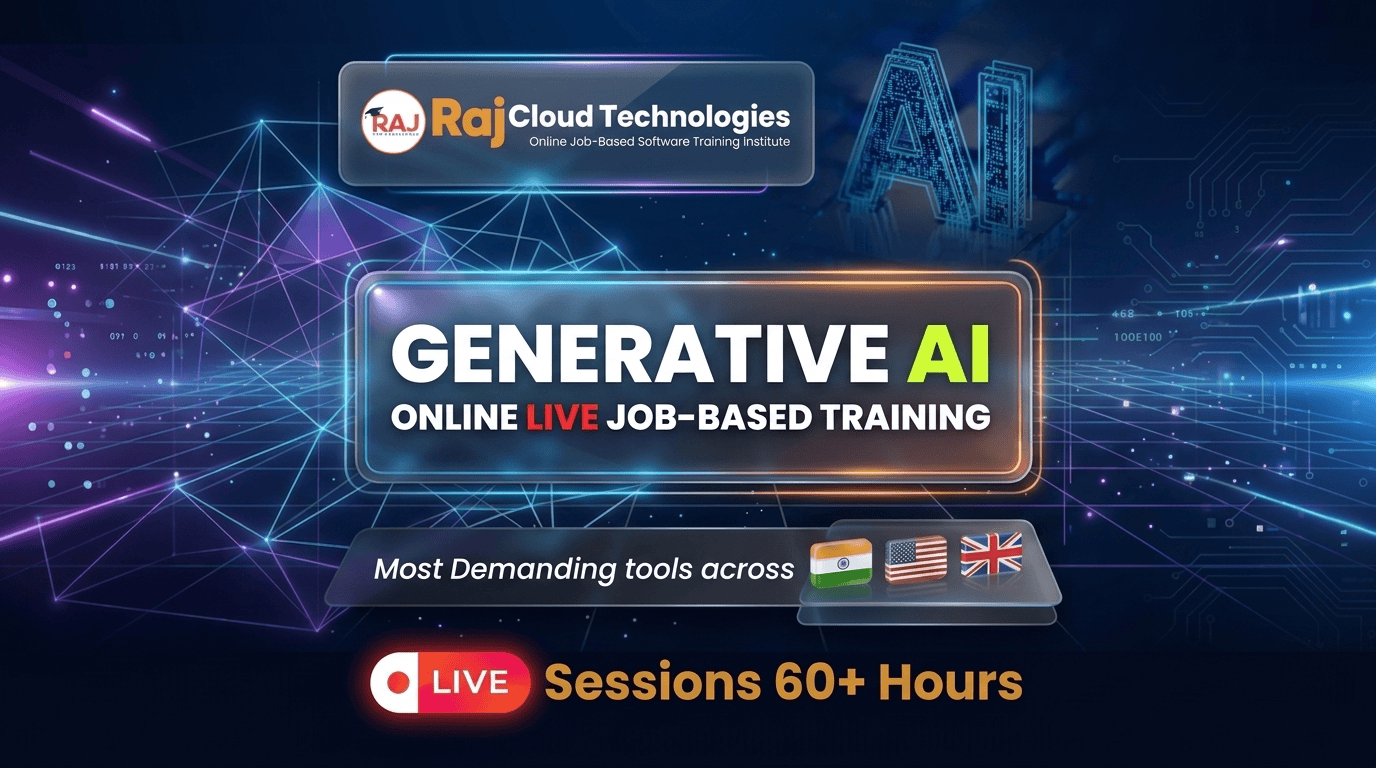
Generative AI (Gen AI)
Go beyond using ChatGPT to building production-grade Generative AI systems. Across two months you'll master the LLM stack that powers every modern AI product — transformer architectures, RAG (Retrieval-Augmented Generation), fine-tuning, vector databases, agentic workflows, and end-to-end deployment. By the end, you'll have shipped a domain-specific chatbot, a document-Q&A system over your own corpus, an autonomous AI agent with tool use, and a code copilot — the exact projects that land Gen-AI Engineer roles paying ₹15-40 LPA.
What you'll learn
- Build a custom chatbot grounded in your own documents using RAG
- Fine-tune an open-source LLM on a domain dataset with LoRA
- Design and ship a multi-step AI agent that uses external tools
- Deploy LLM apps with FastAPI, Docker, and managed cloud services
- Compare and choose between OpenAI / Claude / Llama for any use-case + budget
- Evaluate model outputs with rigorous metrics — not just vibes
- Handle production concerns: cost, latency, guardrails, prompt injection
- Pass technical interviews for Gen AI Engineer roles at top product companies
Technologies Taught
Course Unique Features
- Build 4 production-grade Gen AI projects you can show in interviews
- Live code-along sessions — never theory-only lectures
- Architectures explained from first principles, not API docs
- Daily 90-min live class + weekly project office hours
- Mentor-graded code reviews on every capstone project
- Direct referrals to hiring partners actively looking for Gen AI talent
- Lifetime access to course material — updated as models evolve
- Mock interview rounds covering both ML fundamentals + system design
Job Opportunities
Top job positions you can apply for after completing this training.
| Job Role | Experience | Salary Range |
|---|---|---|
| 1. Generative AI Developer | Fresher to 2+ Years | ₹7–12 LPA |
| 2. Prompt Engineer | Fresher to 2+ Years | ₹6–10 LPA |
| 3. NLP Engineer (LLM-based) | 2 to 4 Years | ₹10–18 LPA |
| 4. Machine Learning Engineer (GenAI focus) | 2 to 4 Years | ₹12–20 LPA |
| 5. AI Application Developer (RAG + LangChain) | 2 to 4 Years | ₹10–18 LPA |
| 6. LLMOps Engineer | 3 to 5 Years | ₹15–25 LPA |
| 7. Vector Database Engineer | 3 to 5 Years | ₹14–22 LPA |
| 8. GenAI Cloud Engineer | 4 to 6 Years | ₹18–28 LPA |
| 9. GenAI Architect | 6+ Years | ₹25–45 LPA |
| 10. Lead Data Scientist (GenAI specialization) | 6 to 8+ Years | ₹25–40 LPA |
You Can Work As
Upcoming In-Demand Jobs
Course Curriculum
Python & Data Structures
36 topics
Python & Data Structures
- •Installation and Setup
- •Installing Python and setting up a development environment (IDEs like PyCharm, VSCode, Jupyter Notebooks)
- •Syntax and Basic Constructs
- •Variables and data types (integers, floats, strings, booleans)
- •Basic input and output
- •Comments and documentation
- •Control Structures
- •Conditional Statements: `if`, `elif`, `else`
- •Loops: `for`, `while`
- •Loop control statements (`break`, `continue`, `pass`)
- •Functions
- •Defining Functions: Parameters and return values
- •Scope and Lifetime: Local and global variables
- •Lambda Functions: Anonymous functions
- •Core Data Structures
- •Lists: Creating, accessing, modifying, and iterating over lists; List comprehensions
- •Tuples: Creating and using tuples; Unpacking tuples
- •Sets: Creating and using sets; Set operations (union, intersection, difference)
- •Dictionaries: Creating and using dictionaries; Dictionary methods and comprehensions
- •File Operations
- •Reading and Writing Files: Opening, reading, writing, and closing files
- •Working with different file modes (`r`, `w`, `a`, `rb`, `wb`)
- •Working with CSV and JSON: Reading from and writing to CSV and JSON files using `csv` and `json` modules
- •OOPs Basics
- •Classes and Objects: Defining classes and creating objects; Instance variables and methods
- •Class Variables and Methods: Using class variables and class methods
- •Inheritance: Single and multiple inheritance
- •Polymorphism and Encapsulation: Method overriding; Private variables and name mangling
- •Exception Types: Common exceptions (`ValueError`, `TypeError`, etc.)
- •Try, Except Blocks: Using `try`, `except`, `else`, and `finally`
- •Scientific Computing
- •NumPy: Arrays and matrix operations
- •Pandas: DataFrames for data manipulation; Reading and writing data (CSV, Excel)
- •Data Visualization
- •Matplotlib: Plotting graphs and charts
- •Seaborn: Statistical data visualization
Generative AI
91 topics
Generative AI
- •GenAI and Its Industry Applications
- •Introduction to Generative AI
- •AI vs ML vs DL vs NLP vs Generative AI
- •Generative AI principles
- •What is the role of ML in Gen-AI
- •Different ML techniques (Supervised, Unsupervised, Semi-supervised & Reinforcement Learning)
- •Applications in various domains
- •Ethical considerations
- •NLP essentials
- •Basic NLP tasks
- •Different text classification approaches
- •Frequency based – Bag of words, TF-IDF, N-gram
- •Distribution Models – CBOW, Skipgram (Traditional approaches) and word2vec, Glove
- •Deep learning techniques – CNNs, RNNs, LSTMs, GRU and Transformers
- •Auto encoders
- •VAE's and applications
- •GAN's and its applications
- •Different types of GAN's and applications
- •Different types of Language models
- •Applications of Language models
- •Transformers and its architecture
- •BERT, RoBERTa, GPT variations
- •Applications of transformer models
- •What is Prompt Engineering
- •What are the different principles of Prompt Engineering
- •Types of Different Prompt Engineering Techniques
- •How to Craft effective prompts to the LLMs
- •Priming Prompt
- •Prompt Decomposition
- •Generative AI lifecycle
- •What is RLHF
- •LLM pre-training and scaling
- •Different Fine-Tuning techniques
- •What is Chunking
- •What is the use of chunking the document
- •What are the traditional effective chunking techniques
- •What are the problems and limitations with traditional chunking techniques?
- •How to overcome the limitations of Traditional chunking
- •Advanced Chunking Techniques:
- •Character Splitting
- •Recursive Character Splitting
- •Document based Chunking
- •Semantic Chunking
- •Agentic Chunking
- •What is RAG
- •What are the main components of RAG
- •High level architecture of RAG
- •How to Build RAG using external data sources
- •Advanced RAG
- •What is LangChain
- •What are the core concepts of LangChain
- •Components of LangChain
- •How to use LangChain agents
- •LlamaIndex
- •What are Vector Databases
- •Why do we prefer Vector Databases over Traditional Databases
- •Different Types of Vector Databases: OpenSource and Close Source
- •OpenSource: Chroma DB, Weaviate, Faiss, Qdrant
- •Close-Source Vector Databases: Pinecone, ArangoDB, Cloud-Based Solutions
- •Supervised Finetuning
- •Repurposing-Feature Extraction
- •Advanced techniques in Supervised Finetuning – PEFT – LoRA, QLoRA
- •Text based LLMs
- •Automatic Evaluation: BLEU Score, ROUGE Score, METEOR, BERT Score
- •Human Evaluation: Coherence, Factuality, Originality, Engagement
- •Automatic Evaluation: Pixel-level metrics, FID (Frechet Inception Distance), IS (Inception Score), Perceptual Quality Metrics, Diversity Metrics
- •Human Evaluation: Photorealism, Style, Creativity, Cohesiveness
- •Automatic Evaluation: FAD (Frechet Audio Distance), IS (Inception Score), Perceptual Quality Metrics – PAQM, PAQM – SNR (Signal-to-Noise Ratio), PAQM – PESQ (Perceptual Evaluation of Speech Quality)
- •Human Evaluation: Perceptual Quality – PQ, PQ-Naturalness, PQ-Fidelity, PQ-Musicality, Task Specific Evaluation
- •Automatic Evaluation: FVD (Frechet Video Distance), Inception Score (IS), Perceptual Quality Metrics, Motion Based Metrics – Optical Flow Error, Content-Specific Metrics
- •Human Evaluation: Visual Quality, Temporal Coherence, Content Fidelity
- •Model Deployment and Management
- •Scalability and Performance Optimization
- •Security and Privacy
- •Monitoring and Logging
- •Cost Optimization
- •Model Interpretability and Explainability
- •Amazon Bedrock, Azure OpenAI
- •What is LangSmith?
- •Applications and use-cases
- •What is agentic AI
- •Building single agent
- •Multi agents by using MCP
- •OpenAI
- •Hugging Face
- •PyTorch
- •TensorFlow
- •LangChain & LangGraph
- •ChatGPT
- •Gemini
- •Copilot
Course Instructed By
10+ yrs of experience educator with expertise in training, fine-tuning, and deploying Generative AI models across Text, Image, Audio & Video domains. Skilled in LLMs, Prompt Engineering, RAG systems, and Vector Databases. Expert in tools like LangChain, Streamlit, AWS Bedrock, OpenAI APIs, Hugging Face, and Pinecone. Strong foundation in ML, DL, and NLP, with a focus on real-world AI applications. Proven ability to deliver impactful GenAI training to professionals and students. Approved trainer by Raj Cloud Technologies.
Approved trainer by Raj Cloud Technologies
Course content
Lifetime access
Watch at your own pace
Certificate included
On 100% completion
Q&A community
Ask anything, get answers
One-time payment. Lifetime access.
Ask anything about this course
Curriculum, fees, schedule, EMI options — drop your question and our admissions team replies within one business day.
- 0 on-demand lessons
- Lifetime access
- Certificate of completion